This post may contain affiliate links. If you make a purchase through these links, I may earn a commission at no additional cost to you. Learn more about our affiliate policy.
Direct flash is unflattering to almost everything, which is exactly why the early 2000s dressed the way it did.
Satin, sequins, metallic, rhinestones, mesh. All of it looks slightly cheap in daylight, and all of it becomes the entire photograph the moment a flash goes off six feet away.
That’s what most modern Y2K styling misses. The clothes were designed for a disposable camera at a house party at one in the morning, and a mirror was never the point.
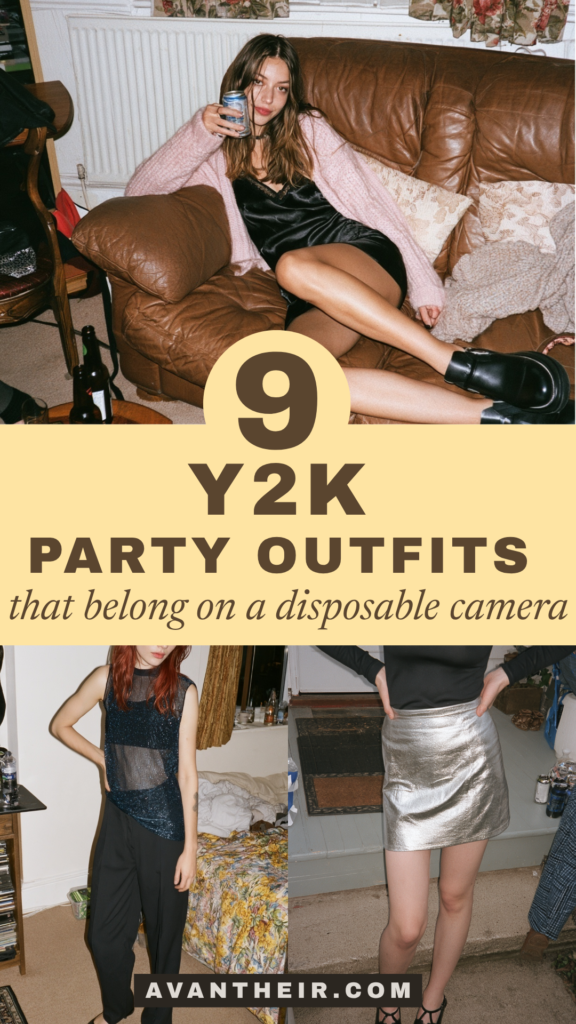
Here are nine outfits built for that. (I’m a little too excited about this one.)
What Makes a Y2K Party Outfit Read Real
A Y2K party outfit falls flat when it feels like a costume, and it feels like a costume when the pieces are new. Reproduction Y2K is made from better fabric than the originals, which sounds good and turns out to be the problem.
The Y2K aesthetic ran on slightly cheap synthetics. Polyester satin over silk, glued rhinestones, mesh that snags. Those materials are what the era really looked like, and secondhand is the only place they still exist honestly.
Three rules keep it out of costume territory.
- One nostalgic hero, two modern basics. The metallic mini, the beaded top, the corset, and then plain black, clean denim, a simple shoe. The high and low mix is what makes it look like clothing.
- Shine in exactly one area, not three. A sequin top wants plain trousers, and a metallic skirt wants a matte top.
- Stop at three era cues. Claw clip, tiny sunglasses, rhinestone belt. Add a fourth and you have crossed into a Halloween aisle.
Dressing for the Flash
This is the part nobody covers, and it’s the difference between an outfit that works in the room and one that works in the photos.
- Satin, sequins, and metallic bounce flash back and become the brightest thing in the frame, which is why the era loved them and why they still photograph unmistakably.
- Rhinestones and glued crystals throw individual points of light, so a small amount reads as sparkle and a large amount reads as glare.
- Mesh and sheer layers catch light at the edges, which gives a photo depth that a solid top does not.
- Matte black disappears entirely under direct flash, which makes it the perfect grounding piece and a terrible hero piece.
- Pure white blows out, so cream and champagne photograph better than optic white every time.
Nine Y2K Party Outfits
Each one is a single shiny thing and a stack of plain around it.
The Satin Cami and Low Rise Bootcut
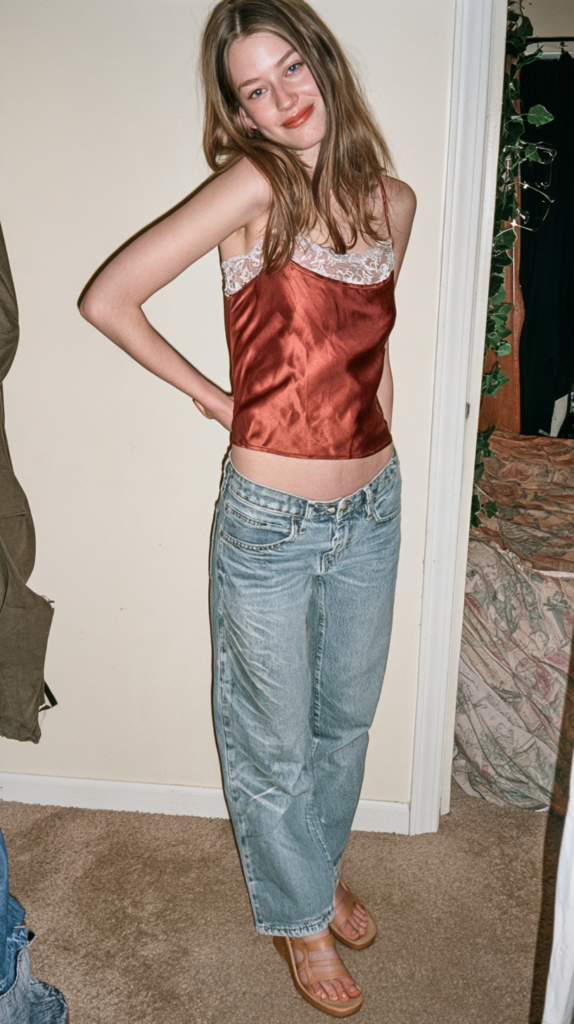
The core going out outfit of the entire era.
A satin camisole with lace trim in champagne or a jewel tone, with low rise bootcut denim and a heeled sandal.
Polyester satin over silk here. It has a harder shine that catches flash the way silk doesn’t, and it’s what everyone really owned. (The one time I’ll tell you to pick the polyester.)
The tell: check the straps where they join the body, since that seam carries all the weight on a cami and it’s the first thing to pull loose. A close-up of the strap seams is worth asking for.
The Beaded Mesh Top Over a Tank
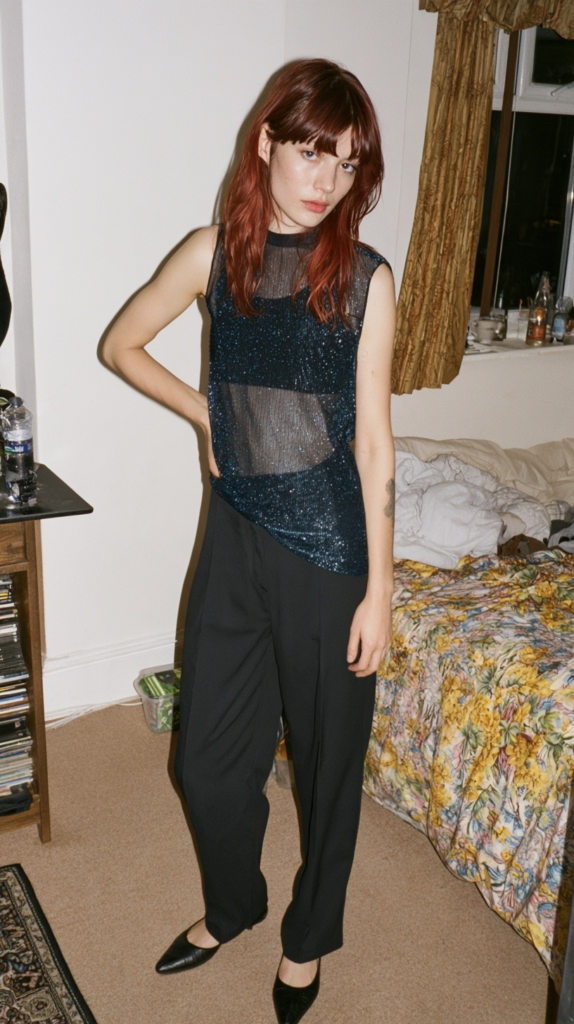
The one that photographs better than it looks on a hanger, by a wide margin.
A beaded or sequined mesh top worn over a plain black tank with black trousers.
The tell: check the beading for loose threads and missing sections. A few gaps are invisible in a photo, but a whole row coming away will keep unraveling all night.
The Metallic Mini and a Plain Black Top
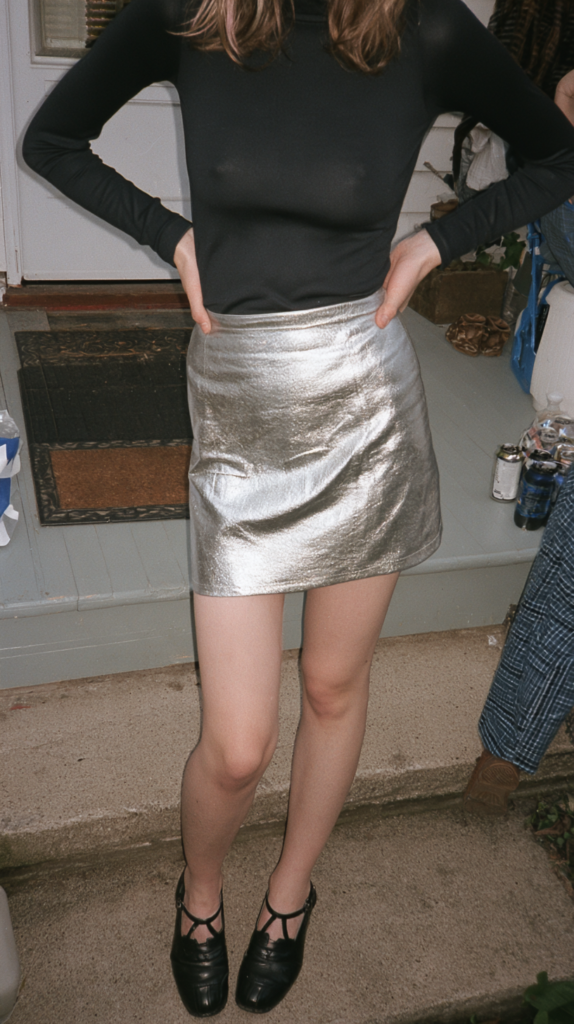
The highest contrast outfit here and the easiest to get wrong in either direction.
A metallic mini skirt in silver or bronze with a fitted matte black top and boots.
The top has to be completely plain. Metallic against anything else with shine tips into costume fast.
The tell: older metallic fabric cracks along fold lines where it has been hanging for twenty years. Open the skirt out flat and look at the creases, or ask for a photo of it laid flat in good light.
Shop the Look
The Halter and Wide Leg Denim
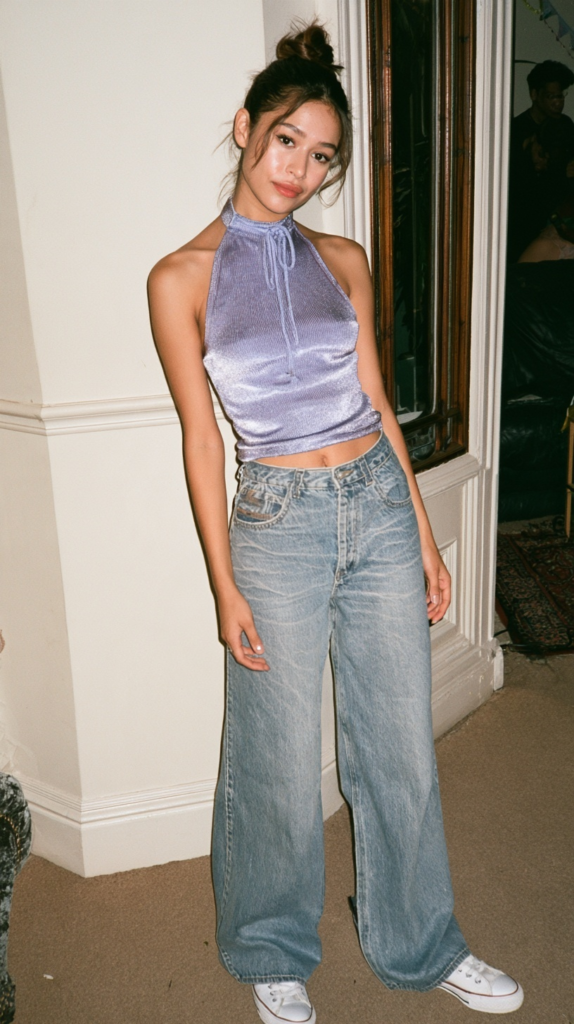
The most comfortable outfit on this list, and the one you can really dance in.
A halter top in a shiny knit or a rhinestone studded fabric, with light wash wide leg denim.
The tell: halters from this era tie at the neck. Check the tie for fraying, since that’s the only thing holding the top up.
Wide leg denim from the early 2000s is heavier than current wide leg, which is why it hangs where newer pairs flare out. Look for 100% cotton on the tag.
The Slip Dress Under a Cropped Cardigan
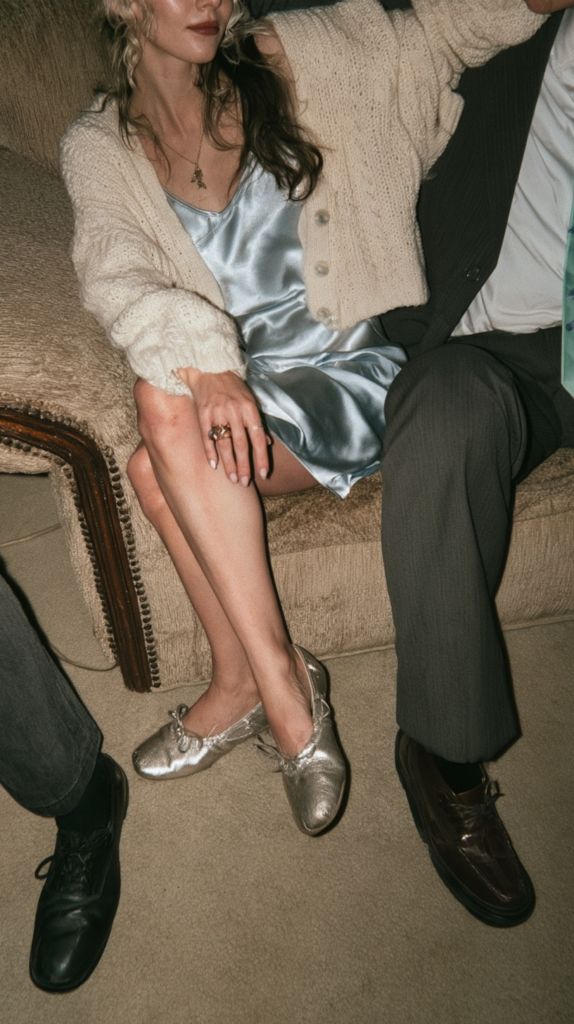
The softest of the nine and the one that works when the party is a dinner first.
A satin slip mini with a tiny cropped cardigan over it, buttoned at the top only.
The cardigan should be truly small. Cropped in this era meant cropped, and a modern proportion loses the reference entirely.
The tell: slip minis from this era are usually polyester, and that’s correct. Check the hem for the tiny rolled finish, which is a fast way to place the garment in the right decade, and it shows in a close-up.
The Rhinestone Baby Tee and Flares
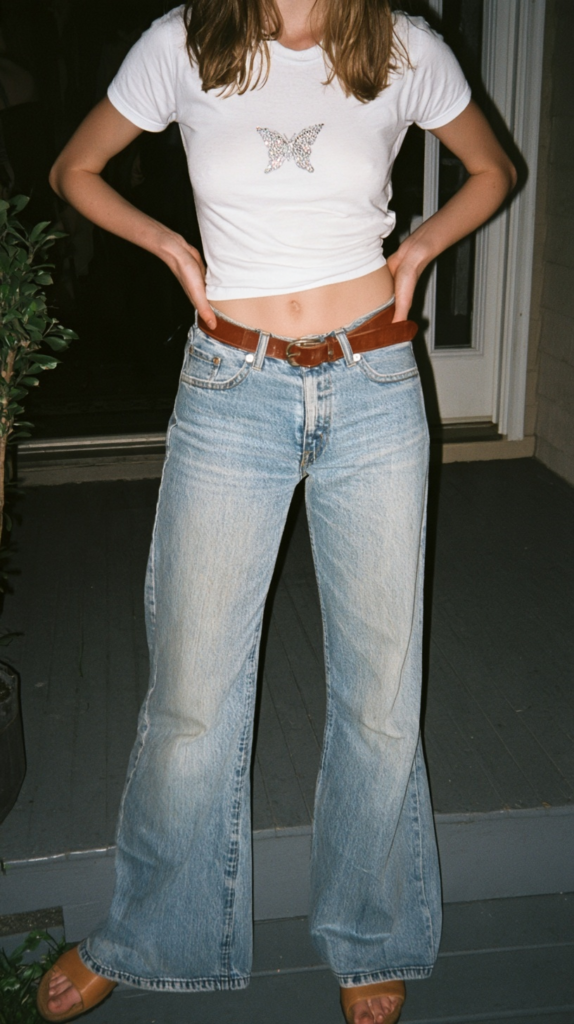
The most specifically 2002 outfit here and the cheapest to find.
A rhinestone graphic baby tee with flared denim and a low slung belt.
The tell: glued rhinestones fall off in the wash, so a tee missing a few stones is period correct. Hand wash it and it stops losing more.
Shop the Look
The Corset Top and Dark Bootcut
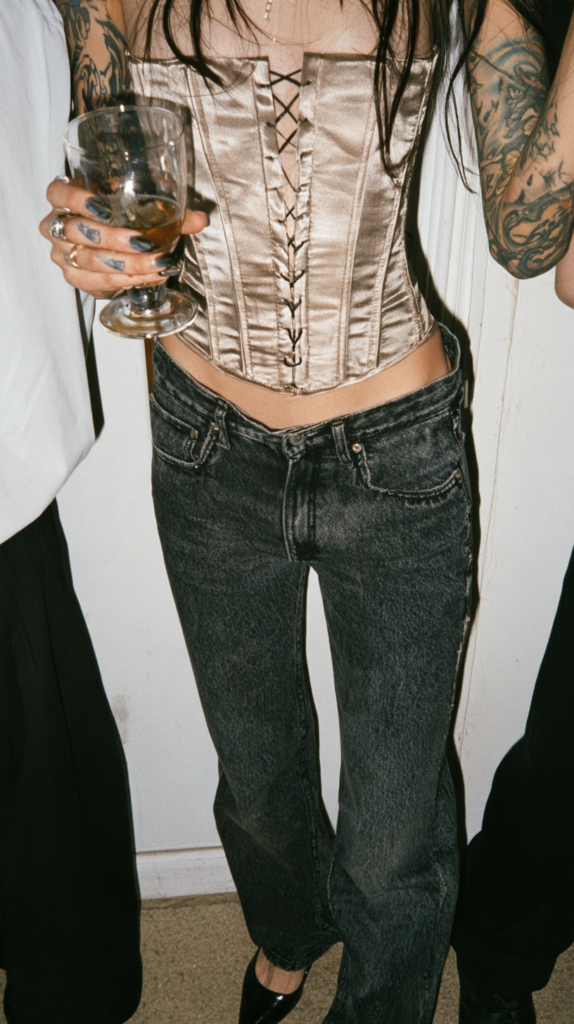
The structured one, and the outfit that feels most current of the nine.
A lace up corset top with dark wash bootcut denim and a pointed heel.
The tell: look for boning you can feel through the fabric, or see as vertical channels in photos, over a stretch panel. A real laced back changes the silhouette, and a fake one just compresses.
Try the lacing before you buy, or ask about the eyelets. Cord replacements are easy, but a torn eyelet isn’t.
The Sequin Shell and Black Trousers
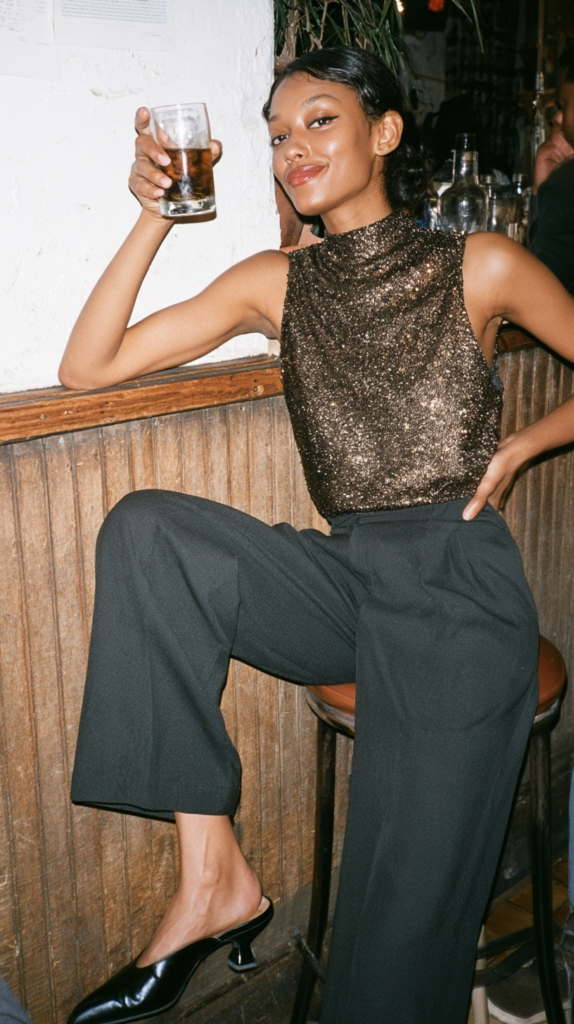
The dressiest outfit here and the one that photographs best under direct flash.
A sequined shell or tank with plain black wide leg trousers and nothing else competing.
The tell: sequin tops live with formalwear year round and get priced as occasion wear, which usually means cheap in August and expensive in December. Run a hand (or an eye, in photos) over the surface for bald patches.
The Faux Fur Shrug Over Everything
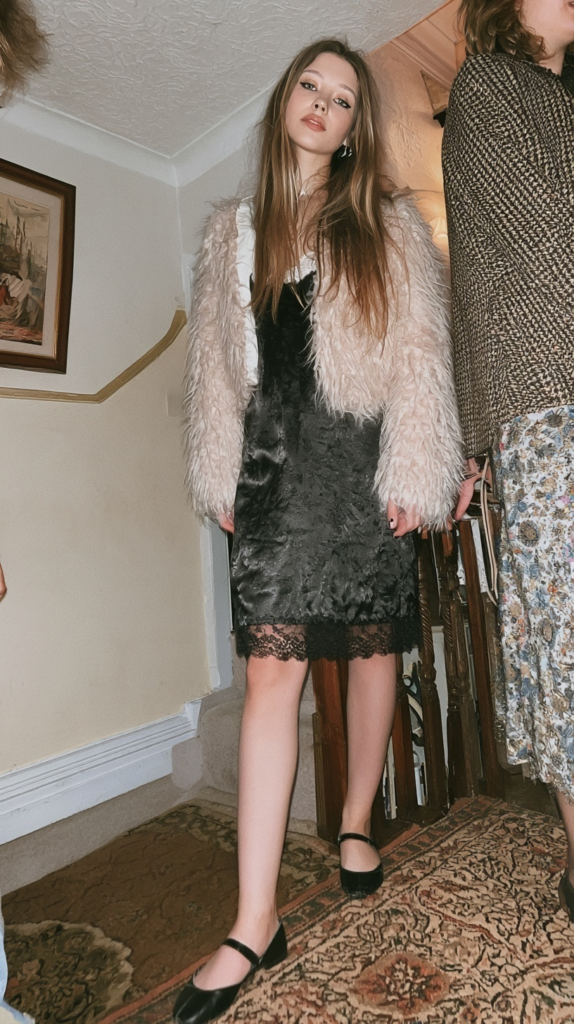
The finishing layer, and the piece that makes any of the eight above say going out.
A cropped faux fur shrug thrown over a cami or a slip dress, in black, cream, or a pastel.
Shrugs and boleros sell for almost nothing because nobody knows what to do with them. Under a flash they catch light at every edge.
Shop the Look
Where the Real Ones Hide
Almost none of this gets sorted as Y2K, in stores or in listings.
- Formal and evening wear holds the sequin shells, the beaded mesh, the shrugs, and the metallic skirts, all sorted by occasion.
- Juniors is where the baby tees and halters end up, and it’s usually the cheapest category anywhere.
- Denim holds the bootcut and the flares, which have been cheap for years because the cut fell out of favor.
- Accessories cover the rhinestone belts and the tiny bags for a couple of dollars.
The tell: checking condition is fast on party clothes.
- Fine. Missing rhinestones, a few gapped beads, and a snag in mesh are mostly invisible in a photo.
- Walk away. Underarm staining on light satin, a broken zipper on a fitted top, and sequins missing in one large patch.
The Short Version
Y2K party dressing was built for a flash going off in a dark room, and the fabrics that do that job are the slightly cheap synthetics that only exist secondhand now.
Pick one shiny hero, keep everything around it matte and plain, and stop at three era cues. That’s the whole formula.
Start with the satin cami. It’s the cheapest piece on this list, it turns up everywhere in every color, and it’s the garment that most reliably says early 2000s the second a camera goes off.