This post may contain affiliate links. If you make a purchase through these links, I may earn a commission at no additional cost to you. Learn more about our affiliate policy.
Most of us put the prairie dresses away in October and pull out something entirely unrelated.
Then in April the dresses come back out, and the wardrobe feels like two separate people who have never met.
The dresses don’t need to go anywhere. They need one layer underneath and one layer over, and both of those layers cost less than the dress did.
Here are the five moves that carry the whole aesthetic through to March. (Move four involves a nightgown, and it’s my favorite.)
What Changes and What Does Not in Cottagecore Winter Outfits
Cottagecore winter outfits use the same garments as the summer version. The silhouette stays put. The fiber and the number of layers are what change.
The cottagecore shapes stay identical, so the tiered skirt is still tiered and the prairie dress is still long. Cold weather versions fall apart when we abandon those shapes for a puffer and leggings, because the silhouette was the aesthetic all along.
The palette does shift, and it goes warmer, not darker. Cream, oatmeal, chocolate, moss, rust, and dusty plum replace the whites and pale florals of summer.
Three things carry over unchanged.
- Natural fiber is still the rule, it just becomes wool, flannel, and corduroy instead of cotton voile and linen.
- One romantic piece per outfit still applies, since layering makes it very easy to end up with three at once.
- The proportion stays the same, meaning full below and fitted above, with the layers going under and over rather than changing the shape.
The Five Layering Moves
Each of these takes a summer piece into cold weather without altering it.
Put a Turtleneck Under the Dress
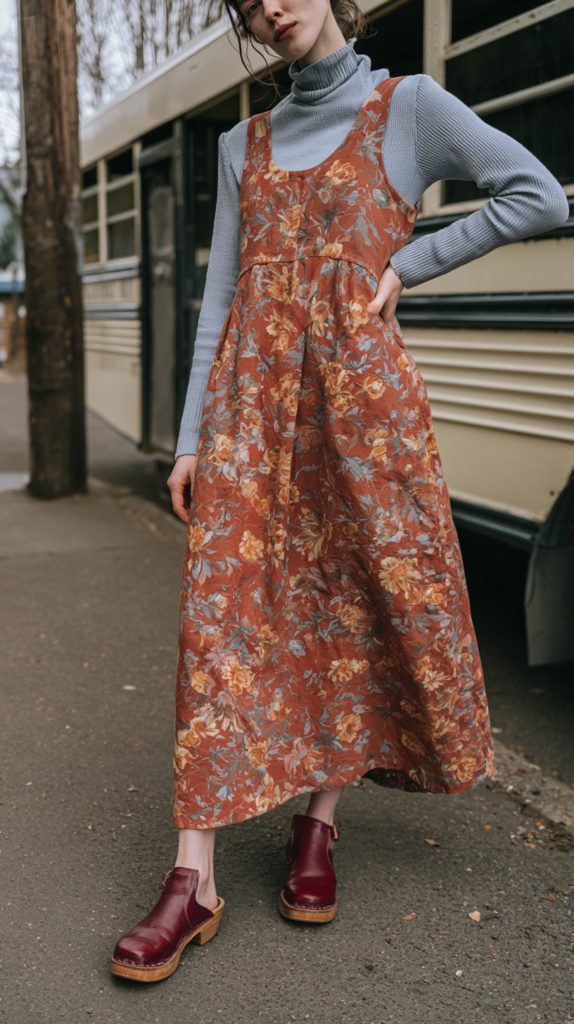
The single most useful move in this entire aesthetic, and the cheapest.
A fine knit turtleneck in cream or oatmeal worn under a sleeveless or short sleeved prairie dress, with the dress unchanged.
Go fine gauge over chunky. A thick turtleneck bunches at the armhole and ruins the line of the dress, while a thin merino disappears under it.
This works on almost every dress you own, which is why I’d want it in three colors.
The tell: thin merino wears through at the elbows first, and pinholes are nearly invisible on cream. In hand, hold the sleeves up to a light. Online, ask the seller directly about holes and look for “merino” on the tag photo.
Shop the Look
Change What Is Under the Hem
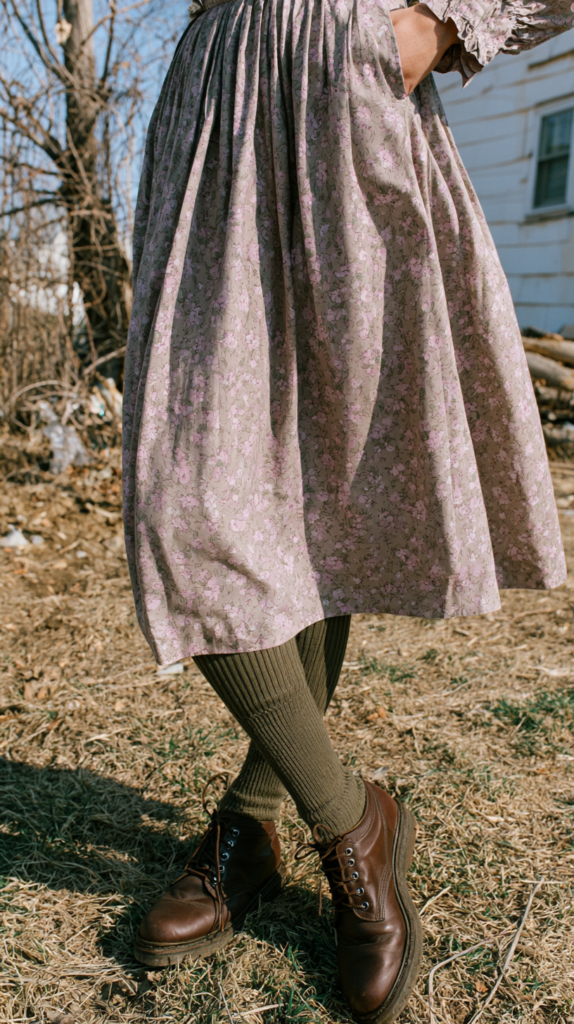
The half of the outfit nobody photographs and the half that determines whether you actually wear it.
Opaque ribbed wool tights in brown, cream, or moss, with a tall leather boot instead of a flat shoe.
Match the tights to the boot, not the dress. A continuous column of one tone from hem to floor makes a long dress look deliberate, and keeps it from looking like you’re just cold.
A cotton petticoat underneath adds warmth and volume at once, which is the trick nobody mentions.
The tell: wool tights are worth the hunt over synthetic. They hold their shape through a whole day where synthetics tend to sag at the knee by lunch, and they sell for very little. Search “wool tights” and check the fiber percentage, since many are blends.
Shop the Look
Layer a Vest Rather Than a Cardigan
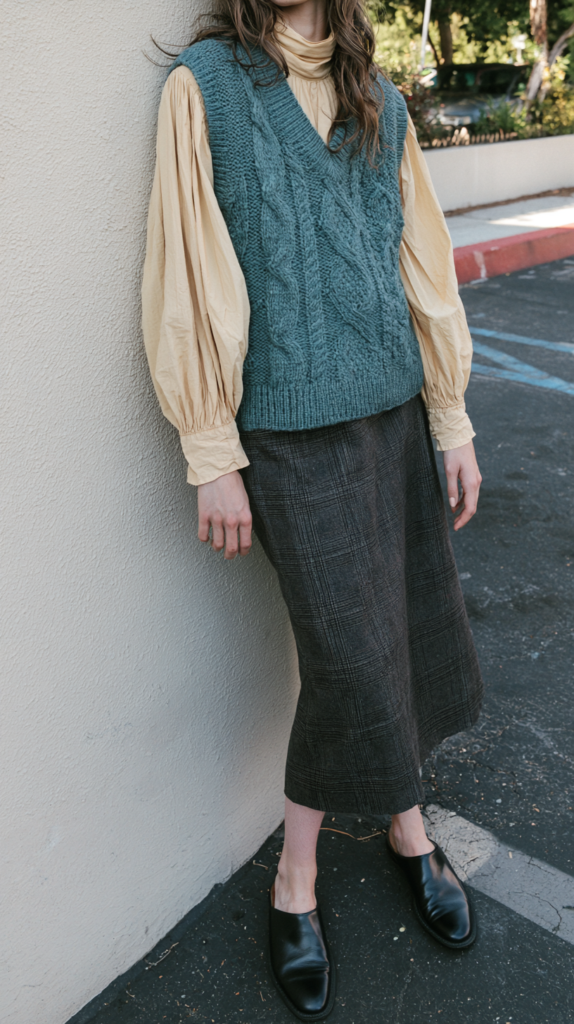
The move that keeps the sleeve of the blouse visible, which is what stops the outfit from looking like a dress with a sweater thrown over it.
A cable knit sweater vest or a corduroy pinafore over a high neck cotton blouse, with a wool skirt below.
Vests add a layer of warmth at the core without adding bulk at the arms, and they leave the puff sleeve or the ruffled cuff doing its job.
This is the formula that goes to work, since a pinafore over a blouse just looks like an outfit.
The tell: check vests at the armhole, which is where old knits stretch out and don’t recover. The body can be loose, but the armhole has to hold. A flat lay photo shows it, since a stretched armhole ripples.
Shop the Look
Swap the Fiber, Keep the Shape
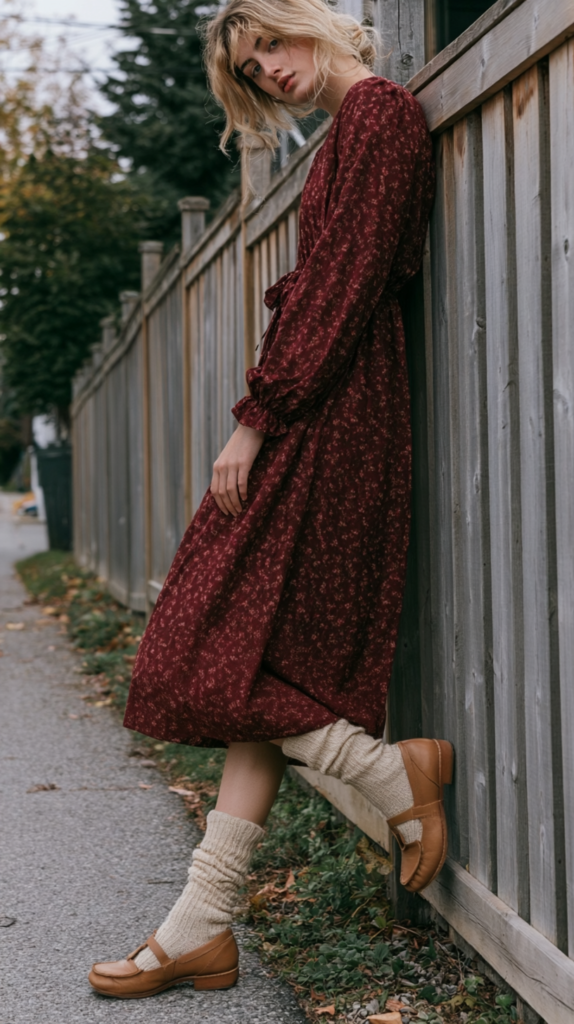
The move that requires buying something, and the one that pays off most over a whole season.
A wool prairie dress in the same silhouette as your cotton one, or a long flannel nightgown worn as a dress.
Winter cottagecore fabrics are wool challis, cotton flannel, wide wale corduroy, and lace knit. All four turn up constantly, and all four stay cheap because they look heavy and dated on a hanger.
Flannel nightgowns in particular are some of the cheapest truly old garments you can buy, since they get sorted as sleepwear and priced as sleepwear. I love them.
The tell: wool challis is the one to learn. It’s a very fine plain weave wool that feels soft and almost fluid where most wool feels scratchy, and it drapes like rayon while being warm. Online, search the words “wool challis” directly and confirm the tag says wool.
Shop the Look
Choose a Coat That Does Not Fight the Dress
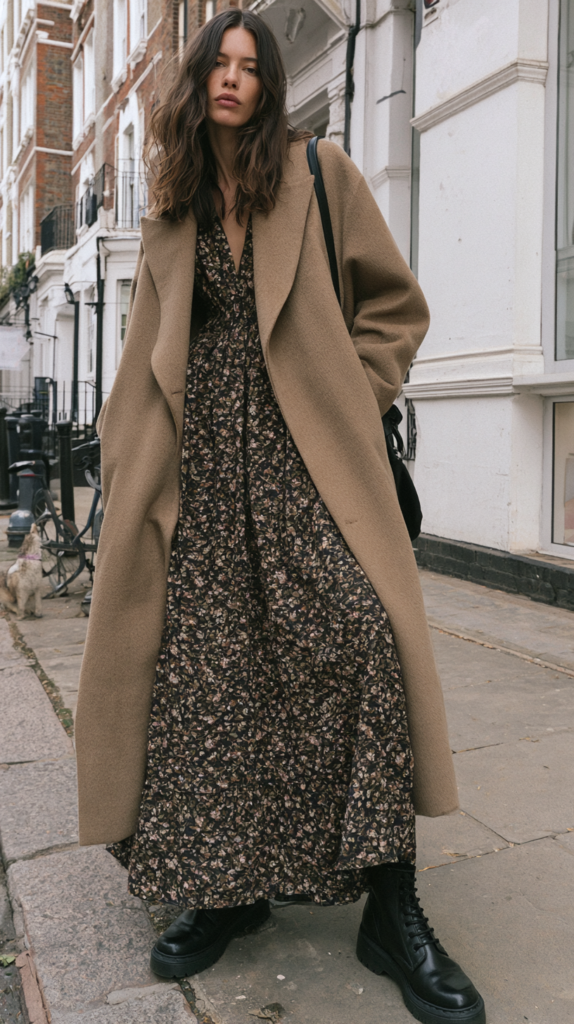
The last move, and the one that goes wrong most often, usually by putting a fitted modern coat over a full skirt.
A wool cape or a shawl collar coat that clears volume underneath, rather than anything belted or tailored close to the body.
A cape solves the problem completely because there is nothing to compress. A swing coat or an unstructured shawl collar does the same job with sleeves.
The tell: length and room are what you’re checking. If the coat has to be fitted, leave it open and let the dress hem show below it. A long dress cut off by a short coat is the most common way this goes wrong, so compare the coat’s length measurement to your dress before you buy.
Shop the Look
The Grandma Wardrobe Advantage
Almost everything on this list came out of somebody’s grandmother’s closet, and that is the fastest way to find it.
Wool challis dresses, flannel nightgowns, cable knit vests, quilted jackets, and lace knit cardigans were wardrobe staples for a generation of women who kept their clothes beautifully, which is why so many turn up secondhand in excellent condition.
They were also built better. A wool challis dress from decades ago has a hand and a drape that’s hard to find at any comparable price now, and it has already survived forty winters.
Estate sales are the concentrated version of this, in person or online. One house often produces an entire seasonal wardrobe in one palette.
The tell: checking old wool is quick.
- Walk away from moth holes. They cluster, so if you find one there are almost always more. Ask the seller directly if the listing doesn’t say.
- Say yes to easy fixes. A fallen hem, a missing button, a tired lining, and light pilling are all cheap to repair on a garment that would cost several hundred to replace.
Buy the Winter Pieces Now
The timing here is lopsided in your favor, and it’s worth knowing.
- Wool and flannel get cleared out of closets in late summer and early fall, before anyone needs them, so selection is at its best and prices are at their lowest.
- Tights, knee socks, and leg warmers are around all year and cost almost nothing at any point.
- Capes and swing coats get passed over because they look shapeless on a hanger, so they stay cheap all season.
- Petticoats and slips get sorted as lingerie and priced as lingerie, which is to say almost nothing.
By December the same pieces cost more and there are fewer of them, so earlier is easier.
The Short Version
Cottagecore’s winter version is the same wardrobe with a layer added underneath and a layer added over.
Put a fine turtleneck under the dress, match your tights to your boots, choose a vest over a cardigan, swap cotton for wool in the same shape, and pick a coat that doesn’t squash what’s under it.
Start with the turtleneck. It costs a few dollars, it works with nearly every dress you already own, and it is the one purchase that keeps an entire summer wardrobe in rotation for five more months.