This post may contain affiliate links. If you make a purchase through these links, I may earn a commission at no additional cost to you. Learn more about our affiliate policy.
Somewhere near you there’s a row of blazers nobody touches, and online there are thousands more sitting on page six.
Wool, mostly brown, mostly men’s, shoulder-heavy and ignored because they look like nothing on a hanger and nobody knows what to do with them.
That’s where dark academia outfits come from, and it’s some of the cheapest good wool you will ever buy. I find this genuinely exciting.
Here’s what to look for, how to tell the good from the fine, and how to build four outfits from what turns up. (The best blazer tell takes two fingers and three seconds.)
What Defines Dark Academia Outfits
Dark academia outfits are built on texture and tailoring more than color. Take the palette away and the tweed, the flannel, and the corduroy still carry the whole thing.
The academia aesthetic borrows from a specific set of references, which is why it holds together so well secondhand. Northeastern prep schools, European university towns, and mid-century menswear tailoring, filtered through a moodier palette than any of those actually wore.
Three rules cover almost every decision you’ll make.
- Texture is the whole point, so herringbone, houndstooth, glen plaid, wide wale corduroy, and cable knit before anything smooth or flat.
- The palette is warm and dim, meaning chocolate, camel, oxblood, forest, charcoal, and cream. Pure black works best as an accent, since head-to-toe black leans goth more than academic.
- Tailoring beats trend, which is why menswear outperforms womenswear for this aesthetic. Classic cuts from thirty years ago are still correct.
The Fabrics and Construction Worth Checking
The tell: turn the garment inside out before you look at the front, or go straight to the tag photos. The tag answers in three seconds what the silhouette takes three minutes to guess at.
- Real wool tweed is dense and slightly scratchy, and it holds a crease you can shake out. A poly tweed feels smooth, looks flatter in photos, and tends to pill at the elbow. It’s fine for a few dollars. It just isn’t the one to hunt.
- A Harris Tweed orb label stitched into the lining means handwoven wool from the Outer Hebrides. It’s a construction standard, it’s easy to spot in a listing photo, and it’s worth searching by name.
- Full canvas on a blazer is the best quality tell there is, and it’s the two finger test I promised. Pinch the front panel and roll it. If you feel a third layer floating between the shell and the lining, it’s canvassed and it will hold its shape for decades. You can’t do this from photos, so online, lean on the fiber tag and the maker.
- Working buttonholes on a sleeve signal real tailoring, and mother of pearl buttons show irregular grain and slight color variation across the set.
- Wool flannel trousers feel soft and slightly fuzzy rather than crisp. They drape in a way no gabardine or synthetic will, and they are consistently underpriced because the fabric reads dated on a hanger.
I’d skip visible logos, saturated colors, and shiny linings that feel slick against your hand.
The Core Pieces Worth Hunting
Six pieces cover the aesthetic. Everything else is a variation.
- A tweed or herringbone blazer is the anchor and the one piece worth being patient about.
- An oxford cloth button down in white or pale blue, ideally with a slightly rumpled collar rather than a stiff one.
- A pleated wool skirt in plaid, houndstooth, or a solid, hitting at or below the knee.
- A crewneck or cable knit sweater in lambswool or merino, sized to layer over a collar.
- Wool trousers in flannel or a wide wale corduroy, hemmed to break once.
- Leather loafers or oxfords that are already a little scuffed, because brand new leather can feel like a costume here.
Where Dark Academia Hides in a Thrift Store
Start in menswear and work your way back to womenswear last.
- Men’s blazers are where the real tweed lives, usually priced lower than women’s blazers and cut better than most of them.
- Small and medium men’s sizing fits this aesthetic better than it fits anywhere else, since the slightly boxy shoulder is period-correct.
- Estate sales in old neighborhoods produce full wardrobes at once, and university towns are the single best geography for this look.
- Accessories are worth a look for a leather satchel or a thin gold watch, which do more for the outfit than another sweater will.
Late summer through early fall is when the most wool shows up, since people clear closets before the weather turns. It’s a good time to look.
Checking condition is fast on tailoring.
- Walk away from moth holes. They cluster, and you rarely find just the one. Ask the seller if the listing doesn’t mention them.
- Say yes to easy fixes. Loose buttons, a fallen hem, and a torn lining are all cheap repairs on a piece that would cost three hundred new.
Four Dark Academia Outfit Formulas
These four are evergreen and cover most of the year. For the seasonal versions, the dark academia outfits for fall and winter go deeper on outerwear and heavy layering.
The Tweed Blazer and Pleated Skirt
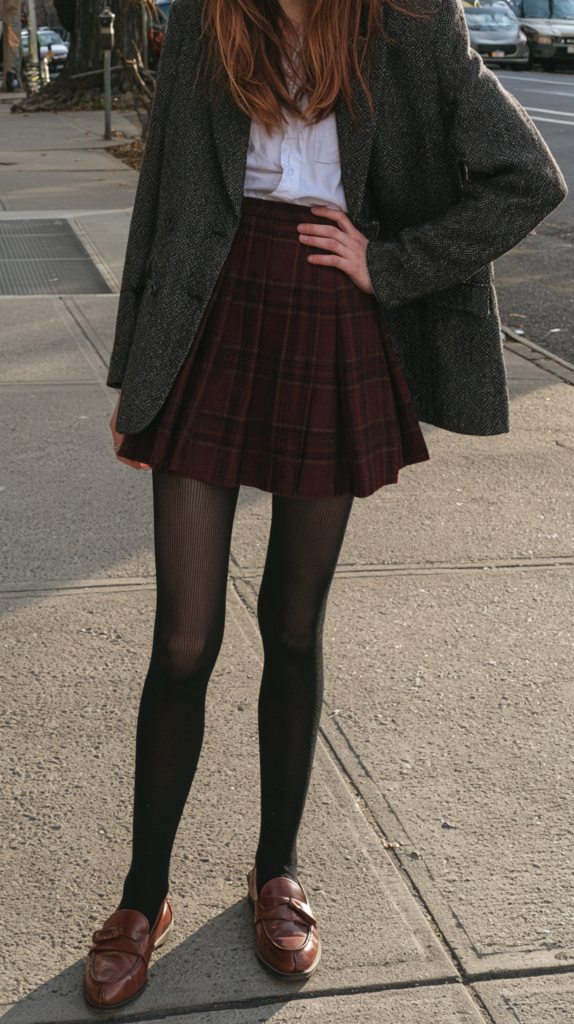
The formula everything else is measured against.
A herringbone tweed blazer over a plaid pleated wool skirt, with ribbed opaque tights and scuffed brown loafers.
The tell: shoulder pads come out in about ten minutes with a seam ripper, so don’t pass on good wool over a silhouette you can change yourself. Check the tag for wool, and compare the shoulder measurement to a jacket you own.
Pleated skirts are almost always cheap, because the pleats look dated on a hanger and completely different on a body. I love that gap.
Shop the Look
The Oxford Under a Crewneck
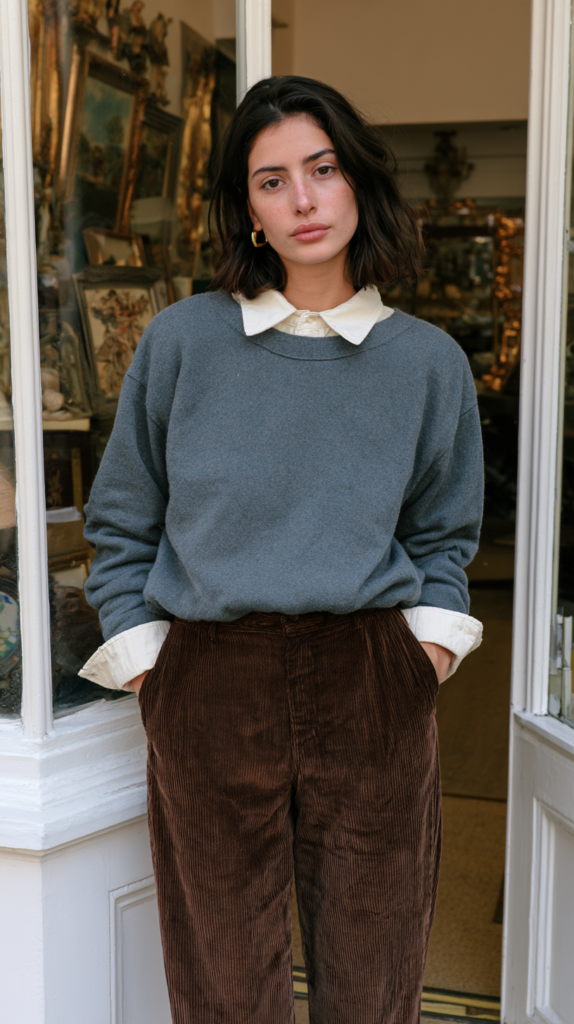
The casual version, and the one you can wear to a coffee shop without anyone clocking it as an aesthetic.
A cotton oxford button down under a navy lambswool crewneck with the collar and cuffs left out, brown wide wale corduroy trousers below, leather satchel carried.
The collar showing is the entire trick. Tuck it in and the outfit disappears into normal clothes.
The tell: check oxford collars for two things: yellowing, which rarely comes out, and light fraying, which is a plus. A soft, slightly worn collar is worth more here than a crisp one. Ask for a close-up of the collar if the listing doesn’t have one.
Shop the Look
The Waistcoat and Wide Trousers
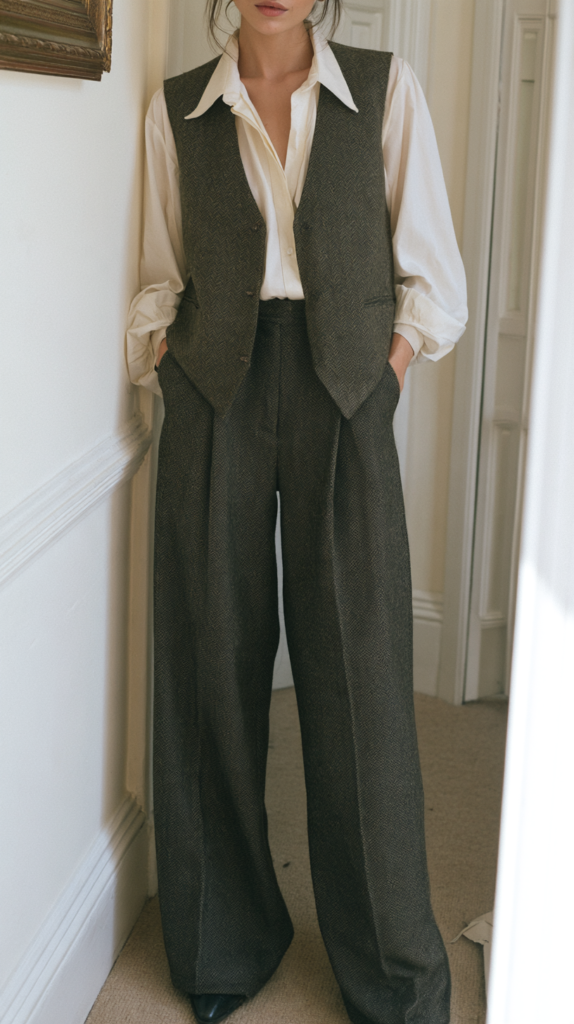
The menswear formula, and the cheapest of the four to assemble because nobody wants a separated three piece suit.
A wool waistcoat over a white collared blouse, charcoal wide leg wool trousers, and flat leather oxfords.
Orphaned suit vests turn up constantly once the jacket and trousers have gone their separate ways. They’re often the cheapest wool you can buy.
The tell: a vest that gaps at the button line can be taken in at the back strap for a few dollars, which is the easiest alteration on this entire list. Go by the chest measurement, and size up if you’re between.
Shop the Look
The Trench Over a Tie Neck Blouse
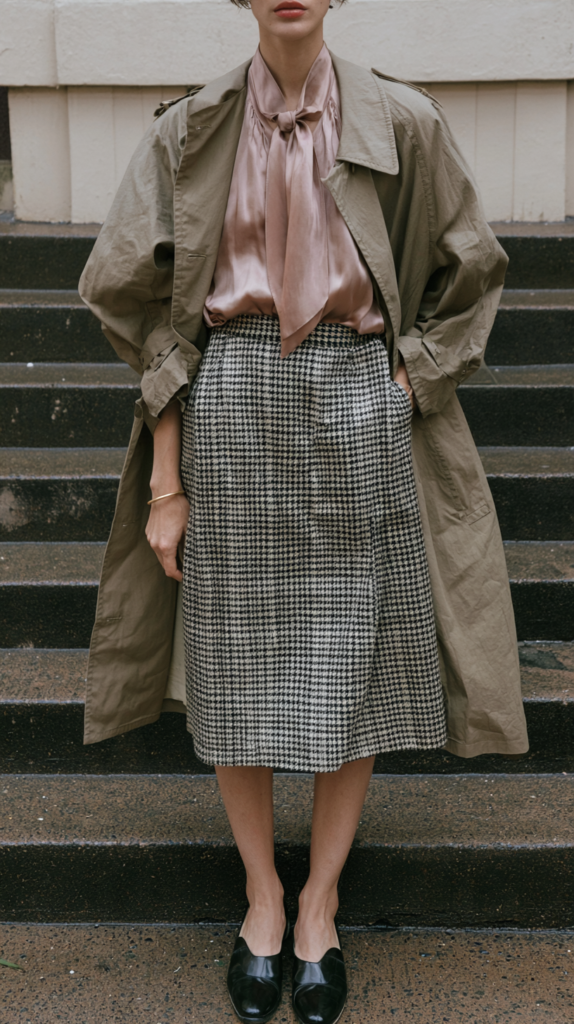
The softest version, and the one that carries dark academia into spring without changing the palette.
A cotton trench coat in khaki or stone over a silk tie neck blouse, with a houndstooth wool skirt and a thin gold watch.
The tell: trenches are worth checking at the shoulder seam and the belt loops. A missing belt is common, and a replacement never quite matches, so make sure the belt is in the photos.
Go for cotton gabardine over a poly blend if you can. Real gabardine has a fine diagonal rib you can see up close, and it softens with age where blends tend to go shiny.
Shop the Look
The Short Version
Dark academia is a texture aesthetic wearing a color palette, which is why it works so well built entirely from wool other people let go of.
Check the fiber tag before the front of the garment, pinch the chest panel of every blazer you can get your hands on, and budget for a tailor over a bigger price tag. Hemming a twelve dollar trouser is one of the best returns in secondhand shopping.
Start with the blazer. It anchors all four formulas above, it’s sitting where almost nobody is looking, and once you have one that really fits, everything else on this list is a ten dollar problem.